Not the hype version. The practical one — from someone who's been building AI-enabled workflows into customer marketing programs for the past two years.
The discourse around AI tends toward two poles: breathless evangelism that promises to automate everything, and defensive skepticism that insists the human elements can't be replaced. Both are wrong. Both are also missing the point.
The more useful question isn't "will AI replace customer marketers?" It's: "what does customer marketing look like when you actually use the tools available to you?" And having built these workflows in practice — not in theory — the answer is: it looks a lot better. Faster, sharper, more scalable, and paradoxically more human, because the humans involved are spending their time on the parts that actually require them.
Here's where it's actually making a difference.
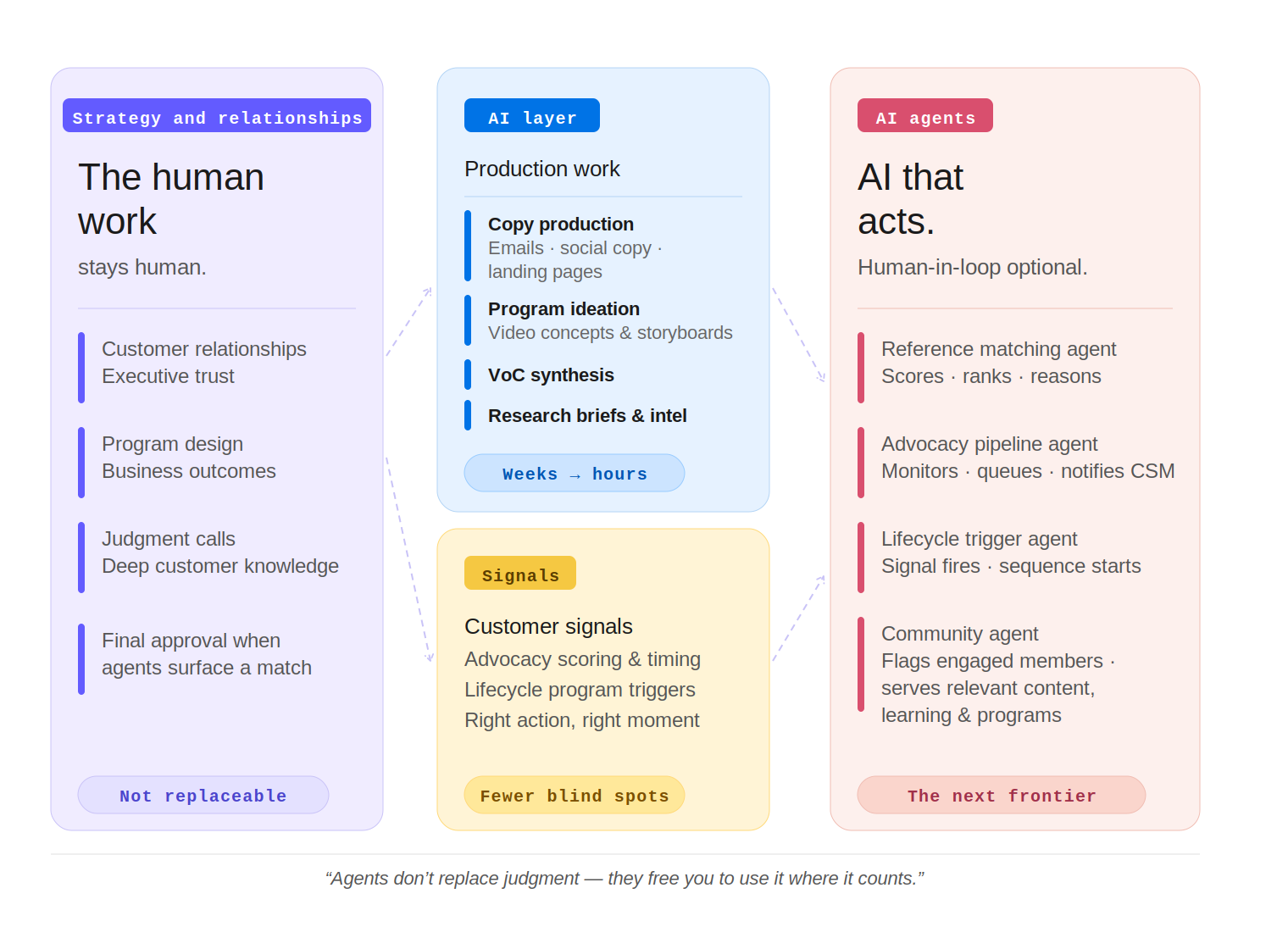
- VoC synthesis at scale: AI turns weeks of manual analysis into hours of continuous insight — grouped by theme, segment, and sentiment across every data source simultaneously.
- Lifecycle content production: AI-assisted drafting compresses a 3-week email sequence project to days, enabling monthly rather than quarterly output.
- Advocacy signal detection: AI monitors NPS, product usage, community activity, and ticket volume to surface the right customer at the right moment — not the same five names every quarter.
- AI agents: Autonomous actors that query, score, and act on signals without waiting to be asked — from reference matching to community onboarding to advocacy pipeline management.
4 real wins for customer marketing teams
01
Voice of Customer synthesis — at a scale that was never possible before
The traditional VoC process looks like this: collect survey responses, pull call transcripts, NPS responses, support tickets, G2 reviews, and community posts, ask CS for anecdotes, spend three weeks trying to reconcile it all into a coherent narrative, present a deck that's already stale by the time it circulates, repeat quarterly.
With AI in the loop, the process looks like this: connect your data sources, run synthesis on demand, get a structured read on what customers are actually saying — grouped by theme, segment, sentiment, product area — in hours instead of weeks. What used to require a project now requires a prompt.
This isn't about removing the analyst. It's about removing the parts of the analyst's job that were never actually analytical: the copying, the categorizing, the cross-referencing. The judgment layer — deciding what matters, what to do about it, how to tell the story — still requires a person. AI just gives that person real information to work with instead of a 47-tab spreadsheet.
Now you can ingest all of those sources simultaneously, surface emerging themes in real time, track sentiment shifts week over week, and produce an executive-ready summary in hours rather than weeks. The insight quality is better because you're working with a complete data set rather than a sample. And you're doing it continuously instead of quarterly, which means you catch signals early instead of after the fact. You can use this insight to report upward, inform decisions, sharpen your buyer and user personas, tighten messaging, and even influence product direction.
02
Lifecycle asset production — from weeks to hours
Customer marketing teams are perpetually behind on content. Not because the ideas or the cross-functional wishlists aren't there. The bottleneck is production: turning a customer story into a case study, a case study into an email, an email into a social post, a quote into a slide. Multiply that by every segment, every use case, every campaign, and you have a team that's always three months behind their own content calendar.
Writing a full lifecycle email sequence — six to eight emails across onboarding, adoption, renewal, and expansion — used to take a seasoned writer two to three weeks. Brief, draft, review, revise, legal, revise again, final approval. By the time it launched, the messaging was already a quarter old.
With AI-assisted production, a well-briefed prompt that includes segment, lifecycle stage, tone, goal, and brand voice produces a strong first draft in minutes. The writer's job shifts from creation to editing and judgment — which is where the real expertise lives anyway. A team that could ship one sequence per quarter can now ship one per month. That's not incremental. It's a different category of throughput.
And the benefits extend well beyond email. AI can now help teams write copy for landing pages, community and learning assets, and webinar programs — and help design community programming tailored to the lifecycle stages and user personas you've identified.
03
Advocacy signal detection — finding the right customers at the right moment
One of the most expensive problems in customer marketing is timing. Ask a customer for a reference too early and you damage the relationship. Ask too late, and someone else has already gotten to them. Ask the wrong customer entirely and you've burned goodwill on a deal that was never going to close anyway.
The signals that predict good advocacy timing exist in your data. NPS scores. Gong calls. Community engagement. Support ticket volume. Feature adoption. Time since last ask. Renewal proximity. The problem isn't that the signals don't exist — it's that no human can monitor all of them, across hundreds or thousands of accounts, continuously, and surface the right ones at the right moment. With AI, you can score advocacy readiness in real time — and surface the right customer at the moment their enthusiasm is highest and their story is most compelling. The ask becomes well-timed instead of opportunistic. Conversion rates go up, and so does the quality of the relationship.
This is exactly what AI is good at. Not replacing the CSM's or customer marketer's relationship with the customer — that relationship is the whole point. But monitoring the signal environment so the human knows when to act, what to ask for, and how to frame it.
04
AI agents — the next frontier
The first three use cases are about AI as an accelerant — making existing workflows faster and sharper. The fourth is about AI as an actor: agents that don't just assist, but do. An agent doesn't wait for you to ask. It monitors, reasons, decides, and executes — autonomously, across multiple steps, often without a human in the loop.
In customer marketing, this is just starting to become real. A reference matching agent doesn't just surface potential customer references — it pulls data from your CRM and beyond, scores each customer against the opportunity profile, weighs NPS sentiment against open support tickets, factors in how recently that customer was last asked, and presents a ranked shortlist with its reasoning. What used to be a 45-minute research task becomes a 10-second query.
The same logic applies to advocacy pipeline management. An agent can monitor product usage spikes, community engagement signals, and NPS score changes simultaneously — and when a customer's score crosses a threshold, automatically queue them for an outreach sequence, notify the CSM, and log the action. No one had to remember to check. No signal fell through the cracks.
In online communities, AI agents can guide a new member through an onboarding sequence, help them connect with peers, and serve them relevant content based on their lifecycle stage, product usage, and data captured across systems — feeding signals back to advocacy systems and your system of record.
This isn't theoretical. The infrastructure to build these agents exists today — natively in tools like Salesforce and in custom-built tools sitting on top of APIs. Most customer marketing and advocacy platforms worth their salt already have agentic capabilities and signal detection built in. The teams that start building this muscle now won't just be faster. They'll be operating at a fundamentally different level of precision.
One honest caveat: agents require clean data, thoughtful guardrails, and a clear definition of where human judgment still needs to sit. They amplify what's already working — and what isn't. Know the difference before you automate it.
What this looks like in practice
| Workflow | Before | After |
|---|---|---|
| VoC synthesis | Manual, quarterly, based on a sample. Output: a deck nobody reads. | Automated, continuous, complete data set. Output: a live dashboard and weekly digest. |
| Lifecycle email | 3 weeks to brief, draft, review, and approve. One sequence per quarter. | First draft in hours, final in days. One sequence per month, segmented. |
| Advocacy identification | Ad hoc, relationship-dependent, same five customers over and over. | Scored, signal-based, surfacing warm advocates at the right moment. |
| Reference matching | A 45-minute manual research task. Often skipped under deadline pressure. | An agent queries, scores, and ranks in seconds — with reasoning attached. |
This is why AI won't take your job. Well, not directly.
AI makes the production work faster and the analytical work deeper. Agents make the operational work autonomous. What none of it does is replace the judgment work — the decisions about what to build, who to build it for, how to earn trust with the right executives, how to design a program that actually connects to business outcomes. The human decides which AI systems and agents to orchestrate, and how, in service of those outcomes.
The teams that get the most out of AI are clear about that distinction. They use AI to compress the time between insight and action. They use agents to eliminate work that never needed a human in the first place. And they protect the work that does.
What they don't do is use AI as a substitute for thinking. The prompts that produce great output aren't generic — they require deep knowledge of the customer, the segment, the lifecycle stage, the business goal, and the brand voice. The agents that work well aren't plug-and-play — they're built on clean data and clear logic. That knowledge and rigor are still human. AI just makes it faster to act on them.
If you're a customer marketing practitioner who hasn't started experimenting with AI workflows yet, the best time to start is now — not because the tools are perfect, but because the practitioners who develop this fluency over the next 12 months will have a meaningful advantage over those who wait. Start small. Pick one workflow — VoC synthesis or email drafting — and build the prompting discipline around it. When you're ready, add an agent layer. The muscle memory compounds fast.
AI doesn't make mediocre strategy better. It makes good strategy faster. Agents don't replace judgment — they free you to use it where it counts.
Frequently asked questions
What are the main ways AI is used in B2B customer marketing today?
The four highest-impact applications are: (1) voice of customer synthesis — ingesting NPS responses, support tickets, call transcripts, and reviews simultaneously to surface themes in hours rather than weeks; (2) lifecycle content production — drafting email sequences, landing pages, and community assets from structured prompts; (3) advocacy signal detection — continuously monitoring product usage, community engagement, and NPS data to surface reference-ready customers at the right moment; and (4) agentic workflows — autonomous AI actors that query CRM data, score customers against opportunity profiles, and trigger outreach sequences without human initiation.
How does AI improve voice of customer (VoC) programs?
Traditional VoC relies on periodic, sample-based analysis — a quarterly project that produces a deck that's already stale on delivery. AI enables continuous, complete-dataset synthesis: connect your sources (surveys, G2, support tickets, call recordings, community posts), run synthesis on demand, and get a structured read grouped by theme, segment, sentiment, and product area in hours. This means catching retention signals early, updating personas in real time, and giving product and CS teams actionable insight instead of a static summary.
What is an AI agent in the context of customer marketing?
An AI agent is an autonomous system that monitors signals, makes decisions, and executes actions across multiple steps — without waiting for a human to initiate each one. In customer marketing, agents handle reference matching (pulling CRM data, scoring customers against a deal profile, delivering a ranked shortlist with reasoning in seconds), advocacy pipeline management (monitoring NPS and usage changes and queuing customers for outreach when readiness thresholds are crossed), and community onboarding (guiding new members through personalized sequences based on lifecycle stage and product data).
Will AI replace customer marketing teams?
No — but it changes what those teams spend their time on. AI compresses production work (content drafting, data synthesis, reporting) and makes operational work autonomous (signal monitoring, triggering sequences, logging actions). What it doesn't replace is judgment: deciding what to build, who to build it for, how to earn executive trust, and how to design programs that connect to revenue outcomes. The teams that win are clear about that distinction — they protect the high-judgment work and use AI to eliminate everything that doesn't require it.
How should a customer marketing team start using AI?
Start with one workflow, not a transformation. The two highest-ROI starting points are VoC synthesis (connect your existing data sources and build a prompting discipline around theme extraction and segmentation) and lifecycle email production (build prompt templates that encode your segment, lifecycle stage, tone, and brand voice). Both produce visible output quickly, build team fluency, and create a foundation for adding agent layers later. Avoid starting with agents — they require clean data and clear guardrails that take time to establish.
What signals does AI use to identify advocacy-ready customers?
The most predictive signals are: NPS score and recency, product adoption depth and feature usage breadth, community engagement role and post frequency, support ticket volume (low open tickets signal a healthy relationship), time since last advocacy ask (customers asked within 30 days score lower), renewal proximity, and call transcript sentiment. AI scores these signals continuously across the full customer base — surfacing warm advocates at the moment their enthusiasm is highest, rather than defaulting to the same five names every quarter.
Curious what AI-enabled customer marketing looks like in practice? We help teams think through their programs holistically — marrying human expertise with agentic capability to get to the next level. Reach out directly or book a consultation. Happy to share what's actually working.

Maria Ogneva is co-founder of Rally, a B2B SaaS customer marketing consultancy. She has spent her career building customer marketing systems that connect every stage of the journey, from onboarding through expansion and advocacy, to measurable business outcomes. At Rally, she helps B2B companies design and scale lifecycle, advocacy, community, reference, and CAB programs as connected systems tied to the metrics that matter to revenue leadership.