From operators who've built the programs — on lifecycle, advocacy, community, CABs, and proving ROI.
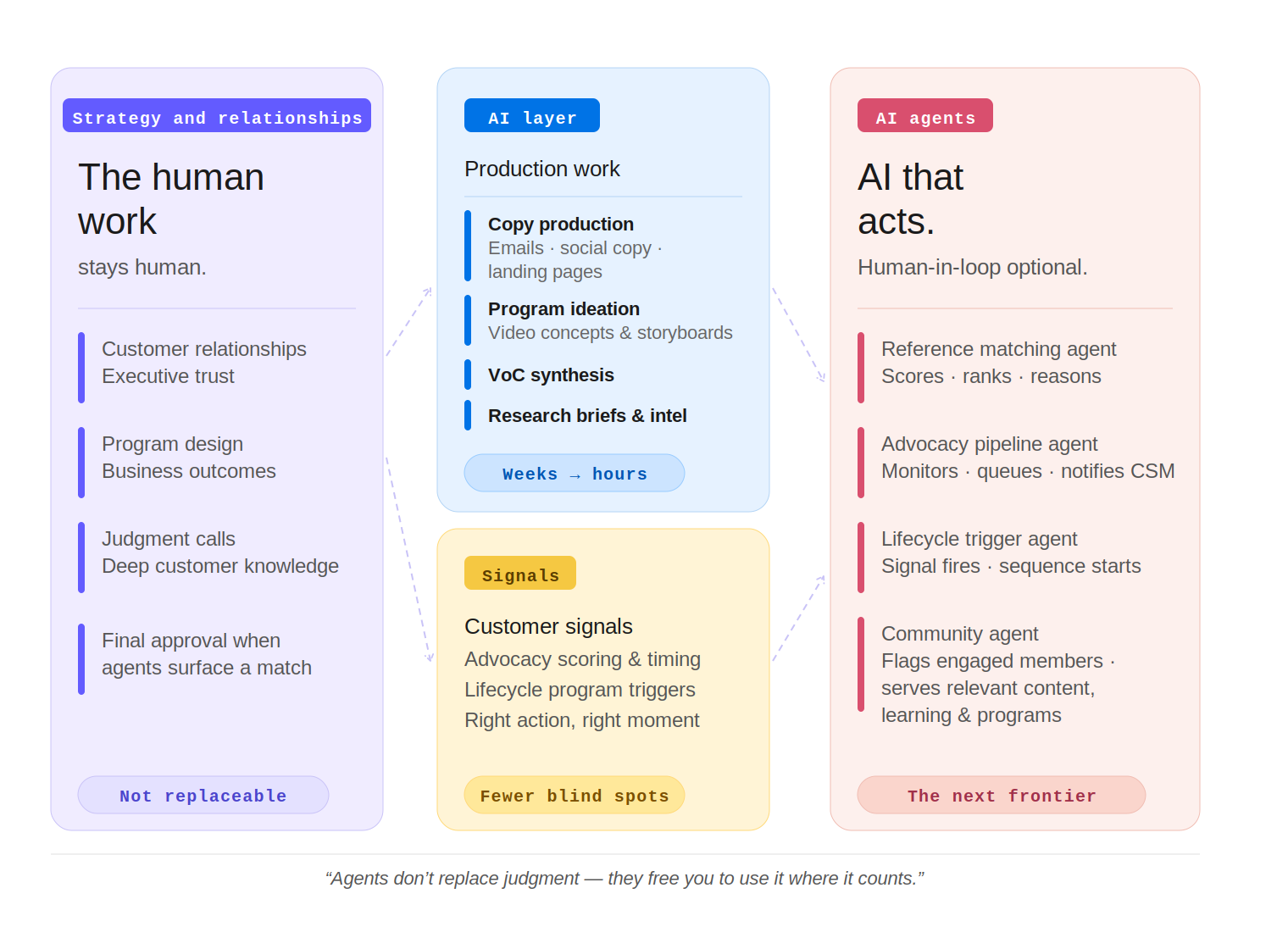
Not the hype version. The practical one — from someone who's been building AI-enabled workflows into customer marketing programs for the past two years. VoC synthesis at scale, lifecycle content in hours, automated advocacy signal detection, and agentic reference matching: here's what's actually working.
How a customer marketing audit exposes the structural gaps quietly burning out your best advocates — and a five-step process to map them and fix them.
Everything we wish someone had told us before we ran our first one. Lessons from dozens of launches, a few failures, and more "we should have known better" moments than we'd like to admit.
What happens to pipeline and NRR when you stop presenting at customers and start connecting them to each other. How peer-to-peer user groups outperform vendor-led programs.
Most B2B customer communities are positioned as engagement programs. That's the problem. Here's how community shows up in retention, expansion, and advocacy data — and how to make the budget case.
How creating direct customer feedback loops helps product teams build around reality instead of assumptions — and why your quietest customers often tell you the most important things.
Why these two program types diverge on member criteria, logistics, facilitation, and follow-through — and how to decide which one to build first.
How we rebuilt a once-a-year trophies event into a year-round system — with categories designed around customers, a content engine fed by winners, and a path in for even the most locked-down enterprise accounts.
How to design a customer awards program that changes how customers see you — naming, sourcing, two-criteria selection, and what actually happens after the trophy is handed out.
Why generic advocacy program names undermine participation before the program launches — and how building an identity around customers instead of vendors changes everything.
Proof tagging, churn detection, champion identification, reference matching — how B2B customer marketing teams use AI to scale trust, retention, and advocacy. Lean teams benefit most.
Running lifecycle, advocacy, and community as a connected system — not three siloed programs — produced a 20% improvement in net revenue retention. Here's how the compounding effect works.
How B2B customer marketers find the signals that actually matter — Gong calls, G2 reviews, user groups, the Product Hero Program, and AI — from someone who built these programs at scale.
Customer marketing isn't a support function — it's a revenue function. Here's exactly how lifecycle programs, champion development, reference programs, and community all move the NRR needle.
Two years. A locked-down enterprise account that couldn't approve public references. What it taught me about advocacy as a spectrum — and why "not public" is not the same as "not an advocate."
Four data inputs, four infrastructure components, four metrics — the complete operational blueprint for a reference program that doesn't collapse under pressure.
Your best reference customers aren't doing it for fifty dollars. A gift card tells them you don't actually know them — and it commoditizes the relationship. Here's what to give them instead.
If you're relying on the same three customers for every reference call, you don't have a program — you have a favor economy. And it breaks exactly when you need it most.
When the same five customers are doing all the reference work, prospects notice — and so does your win rate. How scoring NPS, ICP fit, and advocacy history rebuilt a burned-out program and doubled close rates.
Three specific mistakes that keep even well-intentioned programs from producing the results they should — and what to do instead.
Most companies think they're listening to customers. What they're actually doing is collecting feedback and ignoring it at scale. A case for treating VoC as the most valuable strategic asset you have.
You're spending millions on demand gen. And you're systematically underleveraging the one channel that outperforms all of them — your existing customers.
Two unexpected transitions. Two years. One very clear pattern — and what we decided to do about it. Why disconnected programs never compound, and what a connected system actually looks like.
No fluff. Just field-tested thinking on customer marketing, lifecycle, advocacy, and community — from people who've built it.
No spam. Unsubscribe any time.