What this post covers
- How our awards program got its name — and why naming matters more than you think
- How to source nominations without burning out your team or your customers
- The two-criteria winner selection framework: story strength plus advocacy potential
- Why awards programs generate a different category of advocate than direct ask programs
- How one award winner who had been locked down for two years finally said yes
Most advocacy programs work backward. You identify the customers you want to feature, then you chase them. You pitch the case study. You ask for the reference call. You follow up. You wait. You follow up again. The conversion rate is low, the asks are awkward, and the relationship sometimes feels transactional by the end of it.
A customer awards program inverts the dynamic entirely. Instead of asking customers to do something for you, you give them something first: recognition, visibility, and a stage to tell their own story. What happens next is the part most teams don't anticipate.
We built the Impact Awards from scratch at a former employer. Here's exactly how we did it, what we chose and why, and what the program produced.
Why We Named It the Impact Awards
Naming sounds like a small decision. It isn't. The name is the first signal to customers about what the program is and what it means to be part of it.
We landed on "Impact Awards" for two reasons. It rolled off the tongue and stuck in memory. When you're building a program that depends on word of mouth and internal buzz, you want a name that customers repeat naturally.
Second, the word "Impact." Not "Champions." Not "Heroes." Not "Stars." Impact is outcome-oriented. It signals that we're honoring what customers achieved, not just who they are or how loyal they've been. That distinction matters because it sets up the entire submission and selection process: this is about results, not relationships.
The name is the first signal to customers about what this program means. Choose it like it matters, because it does.
"Heroes" was the name we used for our broader advocacy program. The awards program needed a distinct identity — something that felt earned.
We Built the Categories That People Wanted to Win
We worked with department heads across Sales, CS, Marketing, and Leadership to understand what customer outcomes actually mattered to our business and matched our positioning. What would close deals. What stories our own teams would repeat.
We also created categories that would be appealing to customers. We envisioned acceptance speeches and imagined people accepting these awards. Which ones would be the most coveted? Most aspirational? Most forward-looking? Which ones would they be most proud of? Which ones would they post about on their social networks?
Each category had a natural audience inside the company that cared about it, and a natural audience outside the company that would find it credible.
How We Collected Submissions
The sourcing mechanism is where most awards programs either succeed or fail before they've even started. There are two common approaches: self-nomination (customers submit their own stories) and CSM-sourced nominations (internal teams identify and submit on behalf of customers). We used CSM-sourced nominations, and it was the right call.
3 reasons CSM-sourced nominations outperform self-nomination
- CSMs know which stories are actually compelling. Customers are often too close to their own work to know whether their results are remarkable. A CSM who's seen dozens of customers can recognize a standout outcome quickly.
- CSMs have the relationship to gather the details. A nomination form sent to a customer inbox gets treated like homework. A CSM who calls a customer and says "I want to nominate you for this" gets a 20-minute conversation full of specifics.
- CSM involvement creates internal investment. When a CSM nominates a customer, they become a stakeholder in the outcome. That matters when you need help coordinating logistics, preparing the customer, and sustaining the relationship after the award.
We built a structured nomination form for CSMs that asked for the business outcome, the specific use case, a short narrative of how the customer got there, and an initial read on the customer's interest in sharing their story publicly. That last field was not just a nice-to-have. It directly fed the selection process.
One decision that changed everything: open self-nominations
We also opened the program to self-nominations. This felt risky at first. Self-nominated customers are not always the ones with the strongest stories. But it turned out to be one of the best decisions we made.
Some of our most powerful advocates were customers who nominated themselves. They had already decided they wanted to tell their story publicly. The award gave them a structure to do it. You cannot always predict where enthusiasm lives. Giving customers a door to walk through surfaces advocates you would never have found otherwise.
How We Chose Winners: Two Criteria, Not One
The temptation in awards program design is to select purely on story quality: who has the biggest number, the most dramatic transformation, the cleanest before-and-after. That's a reasonable filter. But it's only half the job.
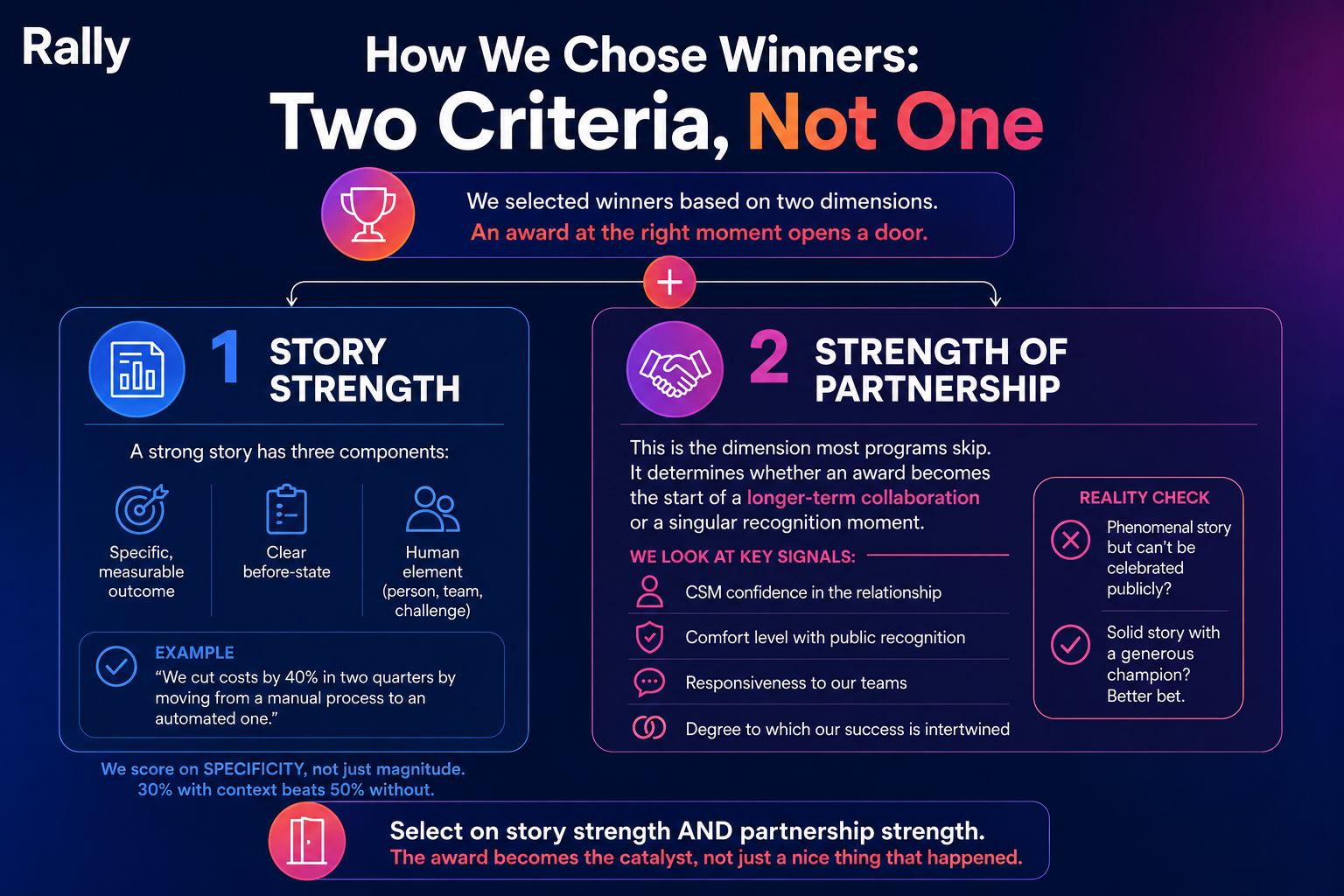
We selected winners based on two dimensions: story strength and strength of partnership.
Criterion 1: Story strength
A strong story has three components: a specific, measurable outcome; a clear before-state; and a human element (a person, a team, a challenge). "We improved our ROI" is not a strong story. "We cut costs by 40% in two quarters by moving from a manual process to an automated one" is a strong story. We scored nominations on specificity, not only magnitude. A 30% improvement with a vivid narrative beats a 50% improvement with no context.
Criterion 2: Strength of partnership
This is the dimension a lot of programs skip, and it's the one that determines whether an awards program becomes the start of a longer-term collaboration or a singular recognition moment.
This dimension asks: is this customer positioned to partner with us on telling their story in a deeper way, elevating their thought leadership and deeply integrating into events and feedback loops? And tactically, would we be able to celebrate them publicly as an award winner? We looked at several signals: CSM confidence in the relationship, the customer's stated comfort level with public recognition, their responsiveness to our teams, and degree to which they consider our and their success intertwined.
A customer with a phenomenal story but a locked-down legal department that blocks all public commentary is a harder bet for the award. A customer with a solid story and a champion who's already been generous with their time is a better one. We tried to find customers where the award itself would be the catalyst, not just a nice thing that happened.
Select on story strength AND partnership strength. An award given to the right customer but at the wrong moment is a one-time transaction. Given at the right moment, it opens a door.
What Happens After: Recognition as a Relationship Shift
For most winners, the recognition experience changed how they saw themselves in relation to the company. They had been customers before. Now they were recognized experts. Now they had a stage. Now they had a reason to show up more, share more, and engage more.
That shift is especially visible with customers who had previously been locked down by legal or PR. One of our most rewarding Impact Award moments involved an enterprise champion who had been unable to participate in any public advocacy for nearly two years — until the award gave his organization a safe, narrow approval to make. If you want the full story on how that unfolded, I wrote about it in detail: How Do You Build Customer Advocacy With a Locked-Down Enterprise Account?
A recognition ask lands differently than a content ask. "We want to honor your results" is easier for a communications team to approve than "We want to write about you." The award creates a public moment the customer can share internally — which is often the political cover needed to move something forward.
The Design Principle Behind All of This
An awards program done right is not a marketing campaign. It's a relationship architecture decision. You're choosing to invest in a moment of genuine recognition that has no string attached in the moment it's given. The return comes later, in the form of customers who have a reason to say yes when you ask for something more.
The name matters because it sets expectations. The sourcing mechanism matters because it determines story quality. The selection criteria matter because they determine advocacy potential. And the follow-through matters most — because an award given without a plan for what comes next is just a trophy.
Design it as a pipeline entry point, not a one-time event. The customers you recognize this year can become your best advocates next year, the year after, and the year after that.
Frequently asked questions
How do you design a customer awards program that generates advocates?
Select winners on two criteria: story strength and partnership strength. A customer with a compelling outcome and a positive posture towards your company and shared success will fuel a long-term relationship that feels natural and meets everyone's goals. The award should be designed as a pipeline entry point, not a one-time transaction.
Should customer award nominations be self-submitted or CSM-sourced?
CSM-sourced nominations outperform self-submissions for awards programs. CSMs know which stories are actually compelling, have the relationship to gather specifics, and become internal stakeholders when they nominate a customer. That said, opening the door to self-nominations surfaces enthusiastic advocates you would never have found otherwise — customers who have already decided they want to tell their story publicly. The best programs use both.
How do you get a customer to agree to a case study if they've said no before?
Reframe the ask. A recognition ask ("we want to honor your results") lands differently than a content ask ("we want to write about you"). Awards programs create a new relationship context that can unlock customers who have previously declined case studies. The award gives legal teams a narrower, more controlled scope to approve.
What should you name a customer awards program?
Choose a name that is outcome-oriented, not relationship-oriented. Words like "Impact," "Excellence," or "Innovation" signal that you're honoring what customers achieved, which sets the right expectation for the entire program. Alliteration helps with memorability and internal adoption. Avoid names that sound like tiered loyalty programs.
How long does it take for an awards program to generate advocacy ROI?
Expect the first real advocacy outputs — case studies, reference calls, event speakers — within one to three months after the awards event. The full advocacy pipeline effect compounds over time as winners become more comfortable and engaged. Plan for at least one full program cycle before measuring pipeline impact, and track the advocacy progression of each winner explicitly.

Maria Ogneva is co-founder of Rally, a B2B SaaS customer marketing consultancy. She has spent her career building customer marketing systems that connect every stage of the journey, from onboarding through expansion and advocacy, to measurable business outcomes. At Rally, she helps B2B companies design and scale lifecycle, advocacy, community, reference, and CAB programs as connected systems tied to the metrics that matter to revenue leadership.