What this post covers
- Why the "five teams, one customer" problem is a systems failure, not a headcount failure
- The five building blocks of a customer marketing audit
- How to run stakeholder interviews that surface what no one will say in a group meeting
- What a gap analysis and operating model actually look like in practice
- How to sequence alignment so it sticks — starting with your exec sponsor, not a committee
A sales rep needs a reference. Someone in product wants a G2 review. Events is looking for a conference speaker. Marketing needs a quote for a campaign. All four go looking for a customer advocate. All four reach out to the same person — because that customer is visible, enthusiastic, and easy to find.
Nobody coordinated. Nobody checked a log. Nobody stopped to ask whether that customer had already been tapped three times this quarter.
This isn't a staffing problem. It's a structural one. And until you map the structure, you can't fix it.
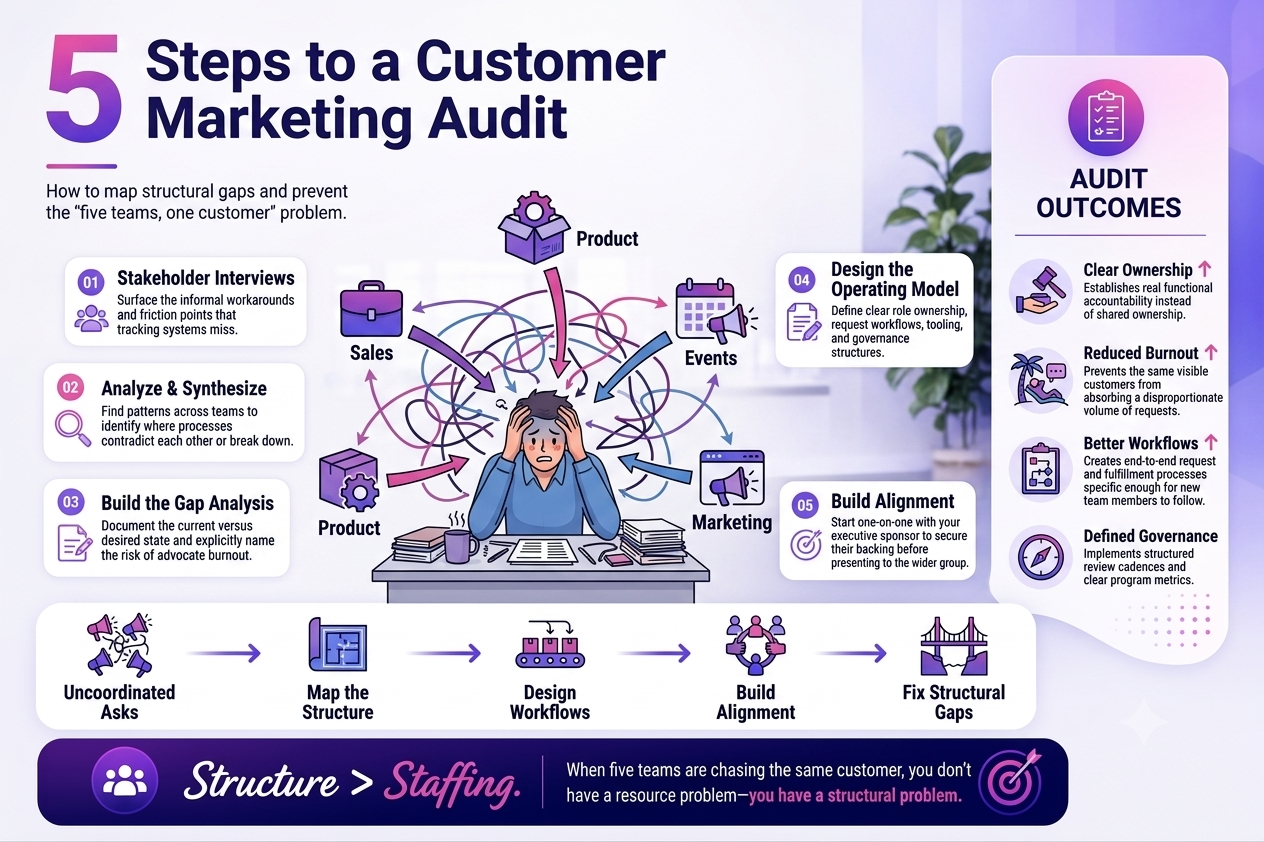
What a customer marketing audit can surface
Most teams that bring in outside help think they need more programs. What they usually need first is a clear picture of what they already have, who owns it, and where it's breaking down.
A proper audit goes broad before it goes deep. The goal in the first phase isn't to find solutions — it's to understand the current state well enough to ask the right questions. In the context of advocacy, that means looking at how advocates are identified and tracked, how requests are routed and fulfilled, how often individual customers are being asked to participate, and where handoffs between teams fall apart.
In most organizations, the handoffs are where the real problems are concentrated.
Step 1
Stakeholder interviews
This is always the starting point — before touching any data or documentation. Interviews surface what systems and trackers can't: the informal workarounds, the friction people have accepted as normal, and the breakdown points that aren't in any deck.
Who you talk to matters as much as what you ask. Yes, you interview the customer marketing team. But you also sit down with sales, CSMs, product teams, events and field marketing teams, and executive leadership. Every one of those functions has a direct relationship with your customer base — and every one of them is making advocacy asks, whether or not customer marketing is in the loop.
- When you need a customer for something, what's your first move?
- How do you know if a customer has already been asked recently?
- Where do requests get stuck, and why?
- What does "a great advocate" look like to your team specifically?
- If you could change one thing about how this works today, what would it be?
The answers rarely align across teams. That misalignment is the data.
Step 2
Analyze and synthesize findings
Once interviews are complete, the work shifts to finding patterns across what you heard. What did multiple people say independently? Where do team perceptions contradict each other? Where's the gap between how a process is designed to work and how it actually runs?
This step can't be rushed. The output isn't a list of complaints — it's a structured picture of where the system is working, where it's under strain, and where it's already broken.
Using the scenario above, the synthesis would surface something like this: four separate teams are making uncoordinated advocacy asks, often to the same customer. There's no shared tracking system and thus no shared data — and as a result, the most visible customers are absorbing a disproportionate volume of requests. That's not an observation. It's a pattern that shows up in multiple interviews, and it has business consequences.
Step 3
Build the gap analysis
The gap analysis puts current state and desired state side by side. For each functional area — advocate identification, request intake, fulfillment, tracking, and recognition — you document what exists today, what's missing, and what the impact of that gap is on the business.
This is also where you name the advocate burnout risk directly. When the same customers are being tapped repeatedly with no coordination system in place, two things happen. First, they start declining. Then they go quiet. By the time anyone notices, the relationship is already strained — and there's often no clear record of why.
A gap analysis makes that risk concrete and gives it a business frame, which is exactly what you need when you bring this to leadership.
Step 4
Design the operating model
The operating model answers one question: if we fixed the gaps, what would this actually look like? It covers who owns what (real functional accountability, not "shared ownership" that belongs to no one), how requests move from intake through fulfillment and tracking, what tools support the workflow, and what governance looks like — who reviews the program, on what cadence, and against which metrics.
This isn't an org chart exercise. It's a workflow design exercise. The output needs to be specific enough that someone new to the team could pick it up and understand exactly how the system runs.
Step 5
Build alignment — in the right order
This is where most audits stall. The findings are solid, the operating model is well-designed, and then everything gets presented to a room full of people who can't make a call together. Nothing moves.
Start with your exec sponsor, one-on-one, before any group presentation. They need to understand the findings, agree with the framing, and be prepared to stand behind the recommendation. Without that, you're walking into a meeting with a report. With it, you're walking in with a position.
From there, align with C-suite stakeholders individually before you bring the group together. Your exec sponsor should be in the room — or at minimum on the calendar invite — when you present to their peers. Then move to marketing leadership and functional leads. The sequence matters: if people don't know their own leaders have already aligned, you'll relitigate every decision from scratch.
By the time you get to a broader team session, there should be no surprises. Alignment is built in direct conversations. Group presentations just confirm what's already been decided.
The coordination failure that burns out your best advocates isn't hidden. It's just unmapped. Once you can see the structure clearly, fixing it becomes an investment and prioritization decision — and not a mystery.
Audits are at the core of what we do at Rally. We audit across all areas of customer marketing: lifecycle, revenue expansion, advocacy, community, and other peer-to-peer programs. If your programs have stalled or your cross-functional processes have gotten muddled over the years, an outsider's eye can spot the predictable patterns fast — and we've seen all the patterns there are to see. Let us know if you want us to take a look.
Frequently asked questions
How long does a customer marketing audit take?
It depends on the size of the organization and the number of stakeholders involved, but a thorough audit typically runs six to ten weeks from kickoff to final operating model. The interview phase alone usually takes two to three weeks, once you account for scheduling across multiple functions.
Who should be involved in a customer marketing audit?
At minimum: customer marketing, sales, customer success, product, and an executive sponsor. Events and communications should be included if they're making direct advocacy asks. The more complete the stakeholder picture, the more credible the findings.
What's the difference between a gap analysis and an audit?
The audit is the full process: interviews, synthesis, gap analysis, operating model, and alignment. The gap analysis is one output of that process — a side-by-side view of current state versus desired state for each functional area. You can't produce a credible gap analysis without the interview and synthesis work that precedes it.
How do I know if my company needs a customer marketing audit?
If more than one team is making advocacy asks with no shared tracking system, that's a clear signal. Other indicators: advocates who've gone cold without explanation, reference requests that consistently take too long to fulfill, or no clear owner for advocate identification and relationship management.
What does an operating model from a customer marketing audit include?
Role and ownership clarity, the end-to-end request and fulfillment workflow, tooling recommendations, and a governance structure with review cadence and program metrics. It needs to be specific enough to act on — not a set of principles that sounds good and changes nothing.

Maria Ogneva is co-founder of Rally, a B2B SaaS customer marketing consultancy. She has spent her career building customer marketing systems at FinancialForce, Invoca, LinkedIn, Sumo Logic, and Yammer — connecting every stage of the journey, from onboarding through expansion and advocacy, to measurable business outcomes. At Rally, she helps B2B companies design and scale lifecycle, advocacy, community, reference, and CAB programs as connected systems tied to the metrics that matter to revenue leadership.