What this post covers
- Why peer-to-peer user groups outperform vendor-led presentations for pipeline and retention
- 4 program design choices that keep user groups running past the first few sessions
- How to use AI to turn each session into months of advocacy content, VoC data, and product feedback
- The one structural difference between user groups that die and ones that compound
Why peer-to-peer works when vendor-to-customer doesn't
There's a reason your best customers trust each other more than they trust you. You have a product to sell. They don't.
When a practitioner in a similar industry explains exactly how they solved a problem your prospect is facing right now, that lands differently than anything your team produces. The language is more honest. The credibility is instant.
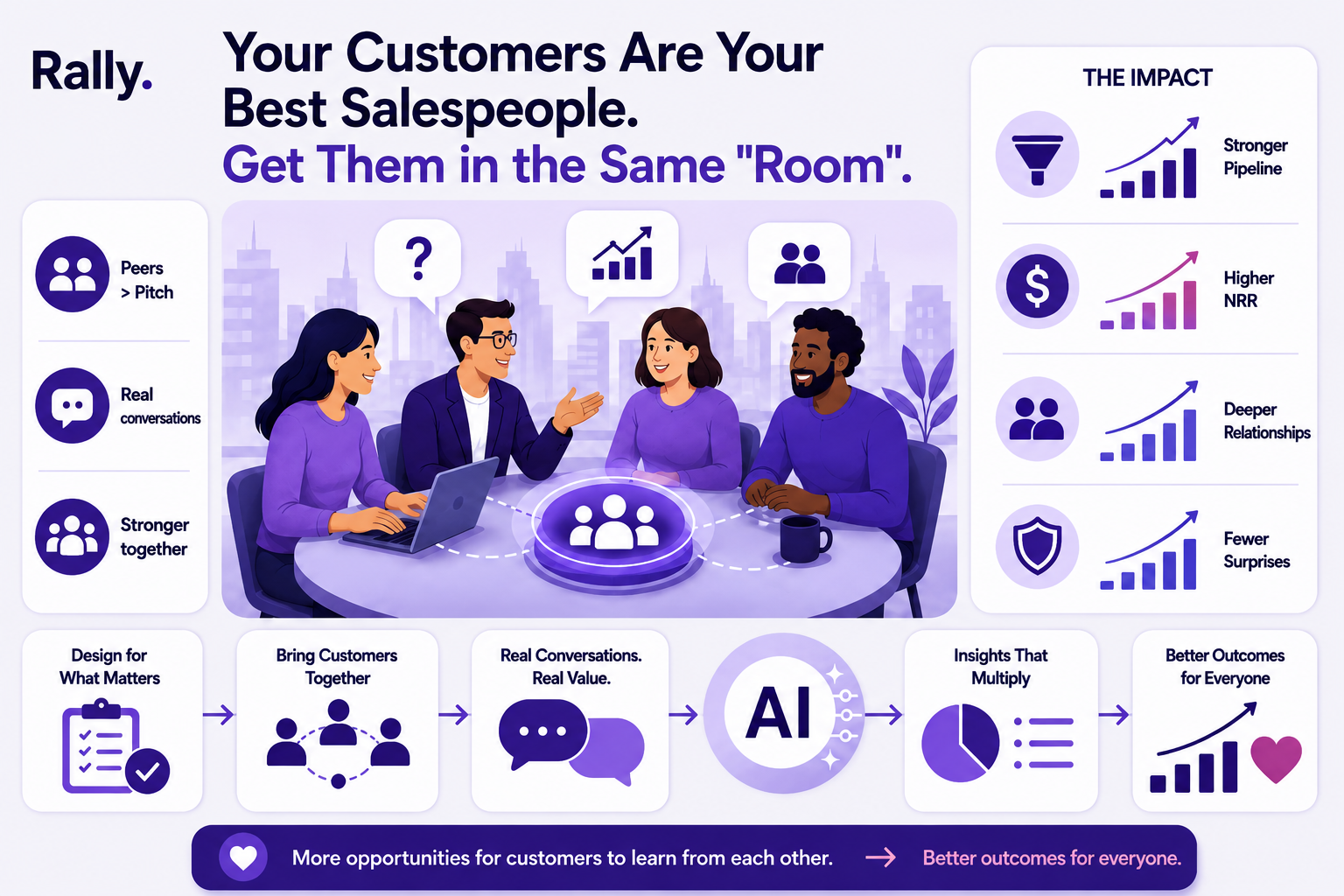
The most effective user groups function as peer forums, segmented by industry and use case, where customers share real outcomes and learn from practitioners who have already solved similar challenges. Each session features a spotlight customer — not a polished marketing story, but actual users talking through what worked and what didn't. Open discussion follows, moderated by subject matter experts there to facilitate, not pitch.
The goal isn't to push content at customers. It's to create a space where they pull value from each other.
The details that made it stick
A lot of user group programs die after three sessions. Here's what separates the ones that scale.
- Collect topic requests at registration so every session is shaped by what customers are actually struggling with, not what you assume they care about.
- Send recordings and key takeaways to every registrant, not just attendees. This extends reach and keeps the program alive between sessions.
- Invite select late-stage prospects into relevant sessions as guests. For niche use cases, authentic peer validation is often more persuasive than any sales deck. Prospects aren't watching a demo. They're sitting in on a real conversation between real users. The trust transfer is immediate.
- Feature a spotlight customer each session — not a polished marketing story, but a real user talking through what worked and what didn't, with open discussion that follows.
The AI layer that multiplied the impact
After each session, many teams stop at distributing the recording. The highest-performing programs go further.
Every conversation becomes a source of customer intelligence. AI can summarize key takeaways, identify recurring themes, extract customer quotes, surface emerging use cases, and categorize feedback for product and customer-facing teams.
Instead of treating user groups as standalone events, they become a continuous source of advocacy content, Voice of Customer insights, customer stories, and product feedback. One conversation can fuel months of value across Marketing, Customer Success, Product Marketing, and Sales.
What it did to the numbers
User groups are most powerful when they operate as part of a broader customer engagement ecosystem that includes advocacy programs, executive engagement, and community-driven learning. Organizations that connect these programs effectively often see measurable improvements in retention, expansion, and customer engagement.
The mechanism isn't complicated. Customers who participate in peer programs are more engaged with the product, more likely to expand, and more likely to surface problems before they become churn conversations. The advocacy compounds. The relationships deepen. The trust grows.
But none of it happens if the program is just a calendar invite with your logo on it.
The mistake most companies make
Most user groups fail because they're built like events. The best user groups are built like communities.
Events focus on attendance. Communities focus on relationships. Events end when the webinar closes. Communities create conversations that continue long after the session is over.
If customers show up only to hear from your company, they'll eventually stop showing up. If they show up to learn from each other, they'll keep coming back. And when they do, retention, expansion, advocacy, and customer trust become natural outcomes rather than goals you have to force.
The gap between an average program and a great one is often smaller than people think. Sometimes it's simply creating more opportunities for customers to learn from each other.
Frequently asked questions
How do B2B SaaS companies run effective customer user groups?
The most effective user groups are structured as peer forums, segmented by industry and use case, where customers share real outcomes rather than sitting through vendor presentations. Each session features a spotlight customer, collects topic requests at registration, and distributes recordings to all registrants. The goal is to create space where customers pull value from each other.
Can you invite prospects to customer user group sessions?
Yes, and it's one of the highest-impact pipeline tactics available to customer marketing teams. Inviting select late-stage prospects as guests to relevant sessions exposes them to authentic peer validation. They aren't watching a demo. They're sitting in on a real conversation between real users, and the trust transfer is immediate. It works particularly well for niche use cases where traditional sales content falls short.
How can AI be used to get more value from customer user group sessions?
After each session, AI can summarize key takeaways, identify recurring themes, extract customer quotes, surface emerging use cases, and categorize feedback for product and customer-facing teams. This turns a single conversation into months of advocacy content, Voice of Customer insights, and product feedback that flows across Marketing, Customer Success, Product Marketing, and Sales.
Why do most customer user group programs fail?
Most user groups fail because they're built like events rather than communities. Events focus on attendance and end when the webinar closes. Communities focus on relationships and generate conversations that continue long after the session ends. When customers show up only to hear from your company, they eventually stop showing up. When they show up to learn from each other, the program compounds.
How do peer-to-peer customer programs affect retention and NRR?
Customers who participate in peer programs are more engaged with the product, more likely to expand, and more likely to surface problems before they become churn conversations. User groups are most powerful when they operate as part of a broader customer engagement ecosystem that includes advocacy programs, executive engagement, and community-driven learning. Organizations that connect these programs effectively see measurable improvements in retention, expansion, and customer engagement.

Nina has spent her career building customer marketing programs that turn satisfied customers into active advocates. At Rally, she helps B2B companies design scalable proof, community, and advocacy systems that drive real pipeline impact.