What this post covers
- Why Voice of Customer fails when it stops at collection and never reaches product teams
- How the Product Hero Program created a direct feedback loop between customers and internal product teams
- Why quiet customers and non-advocates often provide the most valuable product insights
- The 7 feedback categories that changed the quality of internal roadmap conversations
- Why shipping new features before customers adopt current ones creates frustration, not value
- How closing the feedback loop builds healthier trust between customers and internal teams
Most B2B SaaS companies treat Voice of Customer like a reporting exercise. They run NPS surveys, pull quotes into slide decks, and build dashboards full of insights. Then nothing happens.
Product teams keep building features customers barely adopt. Expansion opportunities get missed. Customer frustration grows quietly in the background because nobody is connecting customer reality back to product decisions.
That's exactly why I built Product Heroes.
This was a dedicated group of customers who specifically opted in to provide product feedback directly to internal teams. Not a public advocacy community. Not an open forum anyone could join. These were customers who raised their hands because they wanted to help shape the product experience.
Some were advocates. Some were not.
Some wanted early visibility into roadmap direction. Others simply wanted a direct channel to share what was working, what was frustrating, and where adoption was breaking down inside real workflows.
If product teams are disconnected from customers, they end up building around assumptions instead of customer reality.
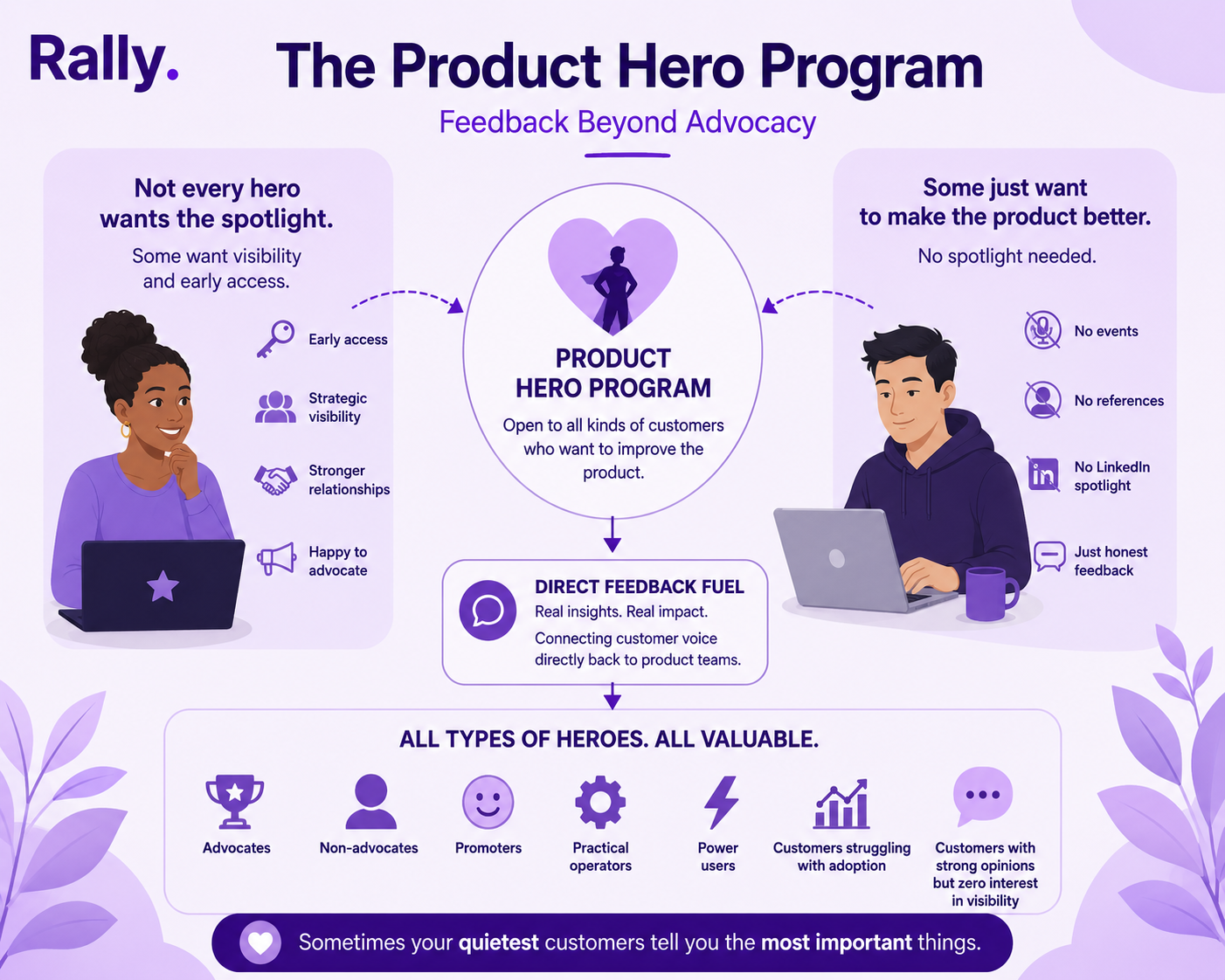
The Product Hero Program: Feedback Beyond Advocacy
My Product Hero Program wasn't an advocacy play.
It was a direct feedback fuel designed to connect customer voice directly back to product teams.
Customers could sign up specifically to provide product feedback. Some were strong advocates who wanted early access, strategic visibility, and deeper relationships with the company.
Others wanted none of that.
They didn't want to speak at events. They didn't want references. They definitely did not want a LinkedIn spotlight. They just wanted to help improve the product.
Perfect.
Because not every valuable customer insight comes from your loudest champions.
Sometimes your quietest customers tell you the most important things.
The Product Hero Program intentionally created space for all types of customers:
- Advocates
- Non-advocates
- Promoters
- Practical operators
- Power users
- Customers struggling with adoption
- Customers with strong opinions but zero interest in visibility
And honestly, those last customers were often the most useful.
How We Turned Customer Feedback Into Product Insight
The biggest difference with Product Heroes was that feedback didn't stop at collection.
We regularly surveyed customers who raised their hands to participate and asked direct questions around seven feedback categories:
- Product adoption
- Workflow friction
- Missing functionality
- Roadmap priorities
- Implementation challenges
- Feature usability
- Operational pain points
Then we routed those insights directly back to internal product teams.
Not into a spreadsheet graveyard. Not into a quarterly report nobody opened again. Into actual roadmap conversations.
That changed the quality of internal discussions significantly because teams were no longer debating hypothetical users or generic personas.
We had direct customer language. Direct customer frustrations. Direct customer workflows.
Real-world context changes product conversations fast.
The Problem With Building "New" Before Customers Adopt the Current Product
One thing this program exposed repeatedly: product teams are often incentivized to build the next thing before customers have fully adopted the last thing.
Meanwhile, customers are still struggling to operationalize features launched two or three years ago.
That disconnect creates frustration quickly. Because customers do not experience products as roadmap slides. They experience them in their day-to-day work.
If implementation is confusing, workflows are clunky, or adoption is weak, shipping more functionality doesn't necessarily create more value. Sometimes it just creates more complexity.
Some of the most valuable Product Hero conversations were not customers asking for giant new innovations. They were asking for:
- Simpler workflows
- Better usability
- Clearer onboarding
- Stronger integrations
- Better operational consistency
- Improvements to existing functionality they already depended on daily
That feedback matters just as much as feature requests. Honestly, sometimes more.
The Lesson That Still Holds
The Product Hero Program worked because it treated customer feedback as something that should actively shape product decisions, not just support reporting.
It recognized something a lot of companies miss: advocacy and product feedback are connected, but they are not the same thing.
Some customers want visibility. Some want influence. Some simply want the product to work better.
All of those customers matter.
The best Voice of Customer programs are not built around collecting feedback for optics. They are built around creating systems where customer insight actually changes decisions.
Listening without action is just performance art.
Frequently asked questions
What is a Product Hero Program in customer marketing?
A Product Hero Program is a closed, opt-in group of customers who volunteer to provide direct product feedback to internal product teams. Unlike an advocacy program, it is not built around public visibility or references. It is built around giving customers a structured channel to shape product decisions.
How do you build a customer feedback loop that actually reaches product teams?
The key is routing feedback directly into roadmap conversations rather than a dashboard or quarterly report. Survey customers with specific questions around adoption, friction, and roadmap priorities. Then bring that direct customer language into internal product discussions — not a summarized version of it.
Should your VoC program include customers who are not advocates?
Yes. Non-advocates and customers struggling with adoption often provide more actionable insight than your loudest champions. Champions have frequently already adapted to product gaps. Customers with adoption friction surface the problems your product team actually needs to solve.
What customer feedback categories matter most for product teams in B2B SaaS?
The most useful categories go beyond feature requests: workflow friction, adoption stall points, onboarding gaps, integration needs, and usability issues with existing functionality. Customers are often less interested in new features than in getting more value from what they already have.
What is the difference between Voice of Customer and a product feedback program?
Voice of Customer is a broader category that includes NPS, surveys, reviews, and customer listening. A product feedback program is a structured subset designed to funnel specific customer insight directly to product teams. The difference is not just collection — it is what happens to the feedback afterward.

Nina has spent her career building customer marketing programs that turn satisfied customers into active advocates. At Rally, she helps B2B companies design scalable proof, community, and advocacy systems that drive real pipeline impact.