We published a post on Tuesday about why peer-to-peer user groups outperform vendor-led presentations for pipeline and retention. The response was strong enough that we wanted to go deeper.
Because philosophy is one thing. The execution is another.
Here's what we've actually learned across dozens of launches, a few embarrassing failures, and more "we should have known better" moments than we'd like to admit.
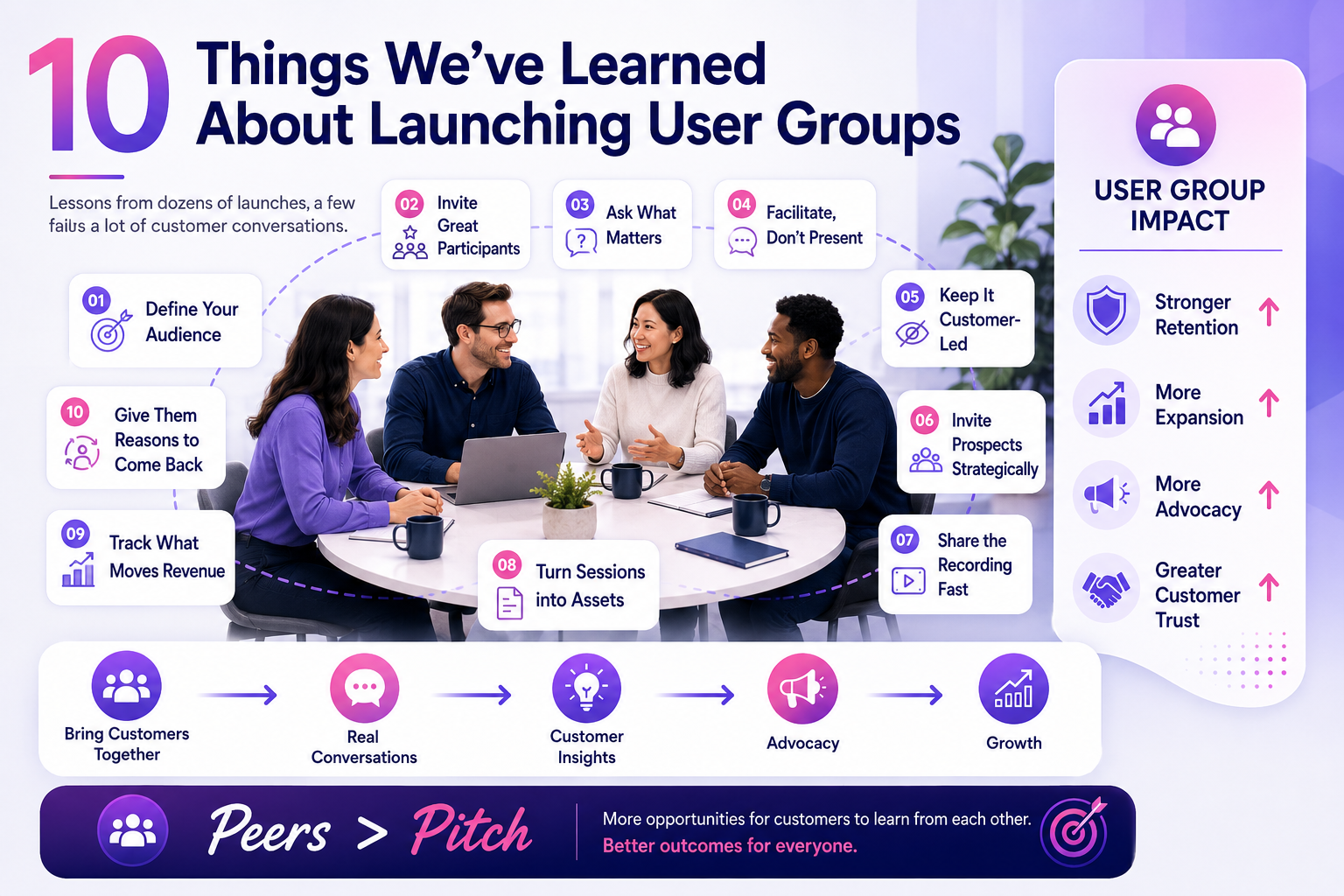
Start with the segment, not the schedule
Someone books six sessions before they've figured out who they're actually for. Don't do that. Segment first. Good options include:
- Industry and sub-vertical
- Use case or job function
- Company size or growth stage
- Lifecycle stage
A room of twenty practitioners who share the exact same problem is worth ten times more than a room of two hundred who vaguely relate to the topic.
Your first three customers are the whole program
The first session lives or dies on who you get in the room. Spend disproportionate time recruiting anchor participants who are genuinely enthusiastic, have a real story to tell, and carry credibility with their peers. If your first three speakers are great, your fourth session has a waitlist.
Ask for topic requests at registration, every time
Non-negotiable. A short question at signup does two things: it tells you what to build, and it signals to the customer that this program was designed for them, not at them.
Try: "What challenge do you most want to hear addressed this quarter?"
The difference in engagement between assumed agendas and requested ones is not subtle.
The moderator is not the host. They're the editor.
A great moderator shapes the conversation, not just facilitates it. They know which threads to pull on, which tangents to cut, and how to surface the insight sitting one layer below what the customer just said.
Don't assign this to whoever has availability. Assign it to whoever is genuinely curious about customers and thinks fast under pressure.
Keep your logo off the agenda as much as possible
Every time your company's name appears prominently, the credibility of the peer conversation drops a little. The moment the program feels like a product webinar in disguise, that trust erodes fast. Your job is to create the container. Let the customers fill it.
Invite late-stage prospects carefully, and only into the right sessions
A prospect sitting in on a genuine peer conversation between practitioners who have already solved their exact problem is more powerful than almost any sales motion. But three things have to be true:
- The session has to be genuinely valuable on its own terms
- The invitation has to feel natural, not transactional
- The prospect has to be far enough along that the format accelerates the relationship
Use this sparingly. When it works, it really works.
Send the recording to everyone, not just attendees
The session is not the asset. The content it generates is the asset. Every registrant who didn't show up is a warm signal. Sending the recording and a tight summary within 24 hours converts a significant portion of them into participants for the next session. Don't let it sit in a folder. Ship it fast.
Treat every session as a content source, not a standalone event
Every session can generate: a VoC summary for Product and CS, quotable customer moments for Marketing, a product feedback digest for roadmap conversations, and a social clip or short-form recap for distribution. In hours, not days. The teams compounding fastest are treating each session as a content engine, not a calendar item.
Measure the right things from the start
Attendance numbers are vanity. Build your measurement framework before you launch. The metrics that connect this program to revenue:
- Repeat attendance rate
- Reference candidates generated within 90 days
- Expansion rate among active participants vs. non-participants
- Deal velocity for prospects who attended as guests
These are the numbers that change conversations with leadership.
Give them reasons to come back
The structural difference between user groups that die after three sessions and ones that scale is simple: did customers come back because of you, or because of each other?
Programs built around your content get abandoned. Programs built around peer relationships get stickier over time. Every design decision should push toward the latter.
User groups are one of the highest-leverage programs in the customer marketing playbook. They're also one of the most underbuilt. The gap between an average program and a great one is rarely about budget. It's almost always about design.
If you're building one and want a gut check, we'd love to hear what you're working on. Get in touch.

Nina has spent her career building customer marketing programs that turn satisfied customers into active advocates. At Rally, she helps B2B companies design scalable proof, community, and advocacy systems that drive real pipeline impact.