What this post covers
- Why a Practitioner CAB and an Executive CAB are built for different purposes, not just different seniority levels
- The member profile, format, and relationship model that define each type
- How the 6-month launch arc plays out for both programs
- The strategic case for each, and how to decide which one to build first
Most CABs are already misdesigned before a single member is recruited. The team has good intentions. The problem is the assumption they start with: that a Customer Advisory Board is a Customer Advisory Board, and the main variable is who gets invited.
It is not that simple. A Practitioner CAB and an Executive CAB are genuinely different programs in terms of member criteria, logistics bar, facilitation approach, and follow-through standard. Build an Executive CAB like a Practitioner one and you will underdeliver for people whose time you cannot afford to waste twice. Build a Practitioner CAB with executive-level overhead and you will exhaust your team long before it finds its rhythm.
This post lays out the strategic case for each: what it is built to do, who belongs in it, and what the 6-month launch arc looks like. The week-by-week detail, templates, and run-of-show are in the planning guides linked at the end of each section.
Before we get into the differences
A Customer Advisory Board is an invitation-only, ongoing forum where a curated group of senior customers co-create strategy with your company. That is what separates it from a reference program, where customers vouch for you, or an advocacy community, where customers amplify you. A CAB is something else: customers who actually consult with you, with real influence over what you build and how you position it.
What makes it work is the reciprocal value. Members give candid input on roadmap, positioning, and strategy. In return, they get early access, a peer community worth being part of, and a seat at a table they actually care about. Remove that exchange and you have a room full of busy people wondering what they signed up for.
Both program types share the same structural requirements: an in-person first meeting, an executive sponsor who is genuinely available and not just named, onboarding interviews with every member before the first session, and a written follow-up within two weeks of every meeting. Where they diverge is in how much each of those requirements costs to execute, and what breaks first when you cut corners.
The Practitioner CAB
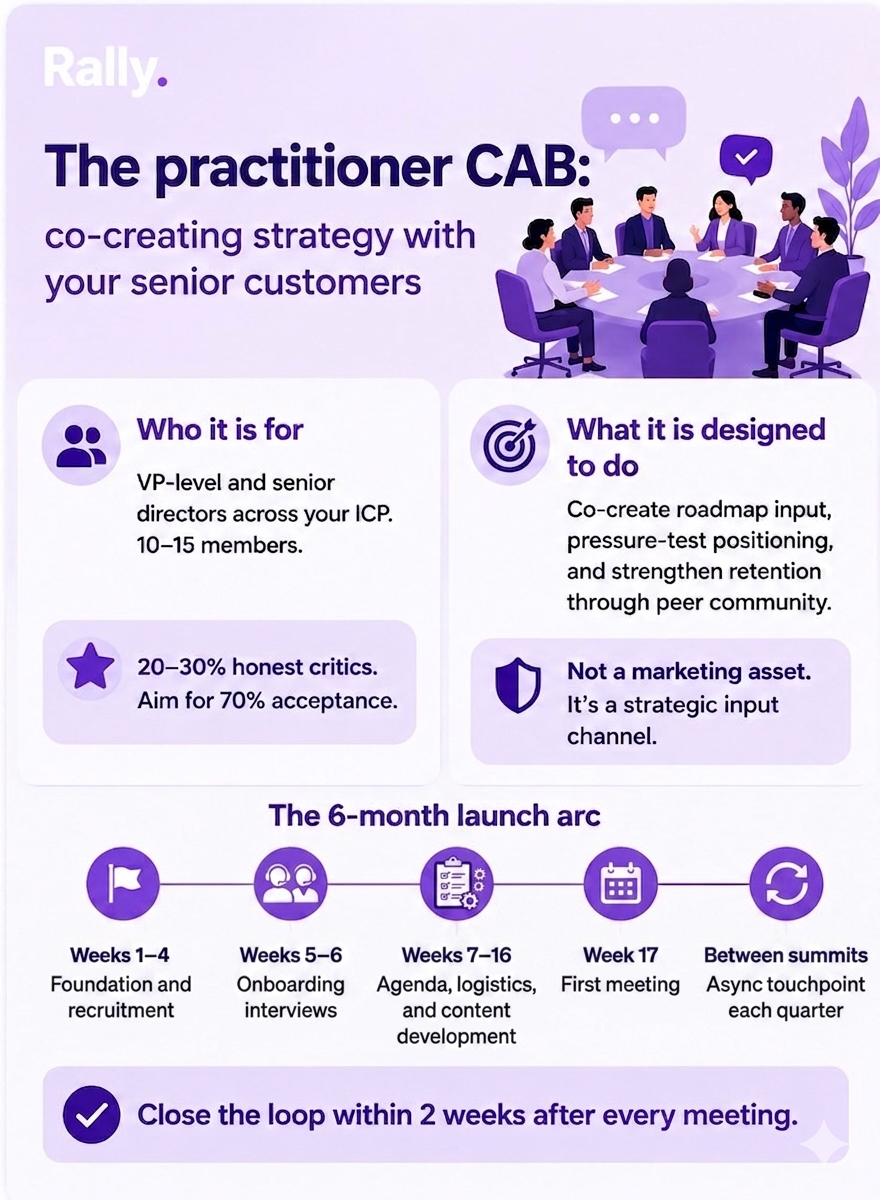
This is the program most companies should build first. It recruits VP-level and senior director customers across your ICP, typically 10 to 15 members, with a deliberate mix of industries, company stages, geographies, and use cases. You want range in the room because companies with identical profiles tend to surface identical problems, and you probably already know about those.
The most common selection mistake is filling seats with your biggest fans. Promoters make the first meeting feel good. They rarely make it useful. You want at least 20 to 30 percent of members who will actually push back — the ones whose CSM notes include something like "has strong opinions" or "direct." Source those candidates from NPS verbatims, QBR participants who already engage at a strategic level, and account teams who know which customers tell the truth. Aim for 70 percent acceptance on outreach. If you are below that, something is off in the invitation, not the list.
What it produces
A Practitioner CAB gives you roadmap inputs that product analytics cannot surface, positioning pressure-tests that win/loss analysis alone cannot deliver, and a peer network that gives members a reason to stay invested in you beyond the product itself. None of that shows up after one meeting. It builds over time, and you often cannot see it accumulating until the second or third session, when members start going off-script in the best possible way.
One thing it is not: a marketing asset. The case studies, references, and pull quotes come eventually, and they tend to come freely — but only after members have stopped performing and started talking. Try to harvest proof too early and the candor disappears. You will know you have made this mistake when the room starts sounding like a press release.
The launch arc
Both programs run roughly 6 months from program brief to second meeting. For the Practitioner CAB, the first 4 weeks are foundation: locking the program's strategic purpose, securing a sponsor who will actually show up, and building member criteria before a single name goes on the list. Recruitment runs through weeks 3 and 4.
Weeks 5 through 10 are preparation: onboarding interviews with every confirmed member, agenda development built entirely from what those interviews surface rather than from what you want to cover, and logistics finalization. The first meeting happens at weeks 11 or 12. The second, where the program deepens and the rhythm sets, runs at weeks 22 to 24.
Between meetings, one focused async touchpoint per quarter is enough: 3 questions maximum, or a 45-minute call on a single topic. What keeps members engaged is not the format of the touchpoint. It is whether they see their previous input reflected somewhere. Close the loop within 2 weeks of every meeting, in writing, naming what you heard and what is moving because of it.
For the full week-by-week planning calendar, member scoring framework, agenda templates, and onboarding interview guide: see the Practitioner CAB Launch Planning Guide.
The Executive CAB
This program operates at a different level of ambition, and a different level of risk. When you ask a CRO or CMO to clear 1.5 days from their calendar, you are making a promise with the invitation. The experience has to justify it before they land. Executives who leave underwhelmed rarely say so directly. They just do not come back, and they remember.
The upside, when the program earns the room it asks for, is hard to replicate any other way. By the third summit, you have executives calling your CEO unprompted, taking reference calls without being asked, and shaping your roadmap before you have committed to anything publicly. That network does not come from a survey. It comes from two or three years of a program that consistently delivered on what it promised.
Who belongs in the room
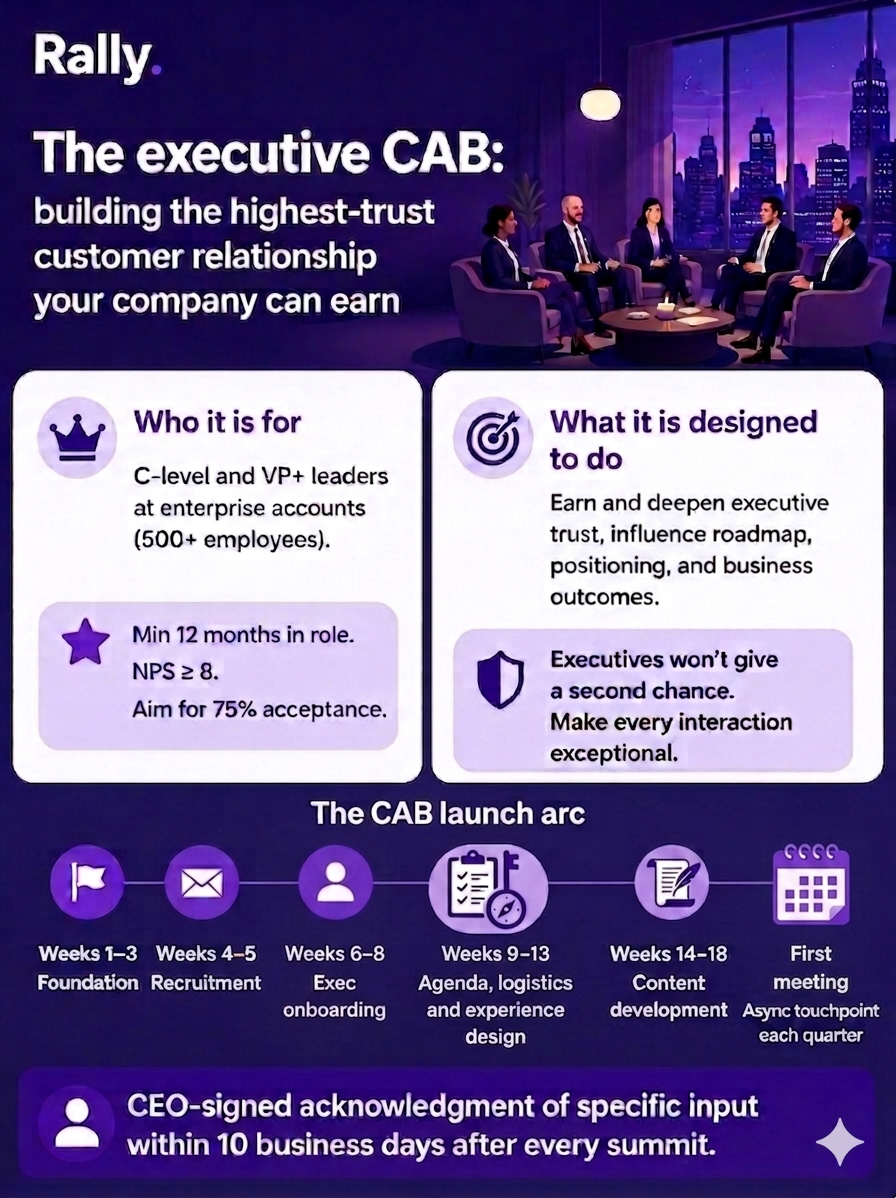
The member bar is tighter on every dimension. C-level or VP+ at companies with 500 or more employees, with at least 12 months in their current role. Tenure matters because an executive who just joined is still orienting — they cannot give you useful strategic input on your product until they have a handle on their own environment. NPS 8 or above, with an active relationship with someone on your exec team or a senior CSM. A transactional account relationship does not become a candid advisory one just because the title changed.
Keep the room at 10 to 14 members. Hold 25 to 30 percent of seats for executives who have a track record of direct feedback — the ones who escalated something, whose CSMs have notes like "high expectations" or "will tell you when something is not working." That willingness to be direct, inside a room where it is actually safe, is what you are trying to create conditions for. Recruitment comes from the CEO or exec sponsor, in personal and individually written invitations. Target 75 percent acceptance. Below that, reconsider the ask before reworking the list.
What it produces
The ROI case is not measured in hours of input logged. It shows up later, in the roadmap decision you made with better information, the competitive positioning that actually landed because real buyers helped shape it, the deal that closed because a CAB member picked up the phone for a prospect who was on the fence. Those outcomes are hard to attribute cleanly to any single program, which is partly what makes the Executive CAB undervalued internally until someone has run one long enough to see what it builds.
There is also an internal effect worth naming. When your CEO co-owns a customer forum at the C-level, it shifts how inputs get weighted across the organization. The voice of the customer stops being a slide in a QBR and starts being something people actually factor into decisions. That is a cultural change as much as a programmatic one, and it tends to compound quietly.
The launch arc
The same 6-month arc applies, but the phases are compressed and the execution bar is higher throughout. Foundation and criteria-setting happen in weeks 1 through 3. Recruitment, led by the CEO or exec sponsor with personal outreach, runs weeks 4 and 5. Executive onboarding calls — shorter at 15 to 30 minutes but just as essential as in the Practitioner CAB — run in weeks 6 through 8.
The format is a 1.5-day destination summit. Day 0 is arrival and a welcome reception: no agenda, no programming, just the first chance for members to meet each other over dinner. It is easy to treat that evening as hospitality. It is actually the relationship-building event that makes the candor possible the next morning, and skipping it shows in the room. Day 1 runs 60 percent facilitated discussion, 20 percent company context-setting, 20 percent peer exchange. No demos. No sales content. If a product question surfaces, take it offline. The agenda comes entirely from what members told you in their onboarding calls. Day 2 closes the loop on commitments from the day before, surfaces anything still unresolved, and locks the next summit date before anyone heads to the airport. Members who leave with a confirmed date come back. Those who leave with a vague follow-up often do not.
Between summits, one focused async touchpoint per quarter, same as the Practitioner CAB. The follow-through standard is higher: a CEO-signed, personalized note within 10 business days of the summit that names what specific members said and what is changing because of it. A generic program summary tells members they were treated as a group. A note that references what they personally said tells them they were heard.
For the full week-by-week planning calendar, the 1.5-day summit run-of-show, white-glove logistics principles, and executive onboarding interview guide: see the Executive CAB Launch Planning Guide.
Where to start
If you are building your first CAB, build the Practitioner version. The capabilities required to run an Executive CAB well — sponsor management, member recruitment discipline, agenda design that actually serves the room, and a closed-loop follow-up process people trust — have to exist somewhere in the organization before you invite C-level executives to depend on them. Running a Practitioner CAB first is how you build that foundation.
The Executive CAB makes sense when you have genuine C-level relationships at accounts that are already strategic to your business, an exec team with real availability to co-sponsor the program, and the organizational readiness to act on hard inputs when they arrive. That last condition is the one most companies underestimate. An Executive CAB that surfaces uncomfortable truths the company has no mechanism to respond to does real damage to those relationships. The program only works if the inputs go somewhere.
Recruit for candor over comfort, build the agenda around what members tell you instead of what you want to present, and close the feedback loop after every meeting without exception. Get those three things right and the program has a chance.
Frequently asked questions
What is the difference between a Practitioner CAB and an Executive CAB in B2B SaaS?
A Practitioner CAB recruits VP-level and senior director customers, runs half-day to full-day sessions, and targets 10 to 15 members across your ICP. An Executive CAB recruits C-level and VP+ leaders at enterprise accounts, uses a 1.5-day destination summit format, and requires a higher logistics bar and a significantly more personalized follow-through standard. The member criteria, format, and relationship investment are each a step up.
How long does it take to launch a CAB from scratch?
Plan for 6 months from program brief to second meeting, for both types. For the Practitioner CAB: weeks 1 through 4 are foundation and recruitment, weeks 5 through 10 are pre-meeting prep, and the first meeting runs at weeks 11 or 12. The Executive CAB follows the same arc, with a compressed foundation phase and higher execution standards throughout.
How many members should a B2B SaaS CAB have?
10 to 15 for a Practitioner CAB; 10 to 14 for an Executive CAB. In both cases, the ceiling exists for a reason: above 15, the room stops feeling like a conversation and the candor you are there to generate tends to drop off.
Should the first CAB meeting be in person or virtual?
In person, for both program types — no exceptions. For the Practitioner CAB, consider anchoring the first meeting to an event members are already attending — a user conference or industry event — to reduce the friction of a dedicated trip. For the Executive CAB, the format is a 1.5-day destination summit with a Day 0 reception. Virtual works well for follow-up touchpoints once the relationships are already established, not before.
When does the Executive CAB make more sense than the Practitioner version?
When you have genuine C-level relationships at accounts that are already central to your business, an exec team with real availability to co-sponsor, and the organizational readiness to act on difficult inputs. Without those conditions in place, a Practitioner CAB will deliver more signal at lower cost to your team and your customer relationships.
How do you keep CAB members engaged between meetings?
One focused async touchpoint per quarter: 3 questions or a 45-minute call on a single topic. What actually drives retention is not the format of the touchpoint but whether members see their previous input reflected in something real. Close the loop in writing after every meeting. For Executive CABs, that follow-up comes from the CEO, references what specific members said, and goes out within 10 business days. A generic summary signals that the listening ended when the meeting did.

Maria Ogneva is co-founder of Rally, a B2B SaaS customer marketing consultancy. She has spent her career building customer marketing systems that connect every stage of the journey, from onboarding through expansion and advocacy, to measurable business outcomes. At Rally, she helps B2B companies design and scale lifecycle, advocacy, community, reference, and CAB programs as connected systems tied to the metrics that matter to revenue leadership.